Custom Directional Signs: Help Visitors Navigate Your Space With Ease
A visitor who cannot find where they are going is a frustrated visitor. Whether they are trying to locate your conference room, the employee restrooms, the loading dock, or the executive suite, every unnecessary wrong turn costs time and creates a negative impression. Custom directional signs eliminate that friction.
The Design Principles Behind Effective Directional Signs
Clarity Above All Else
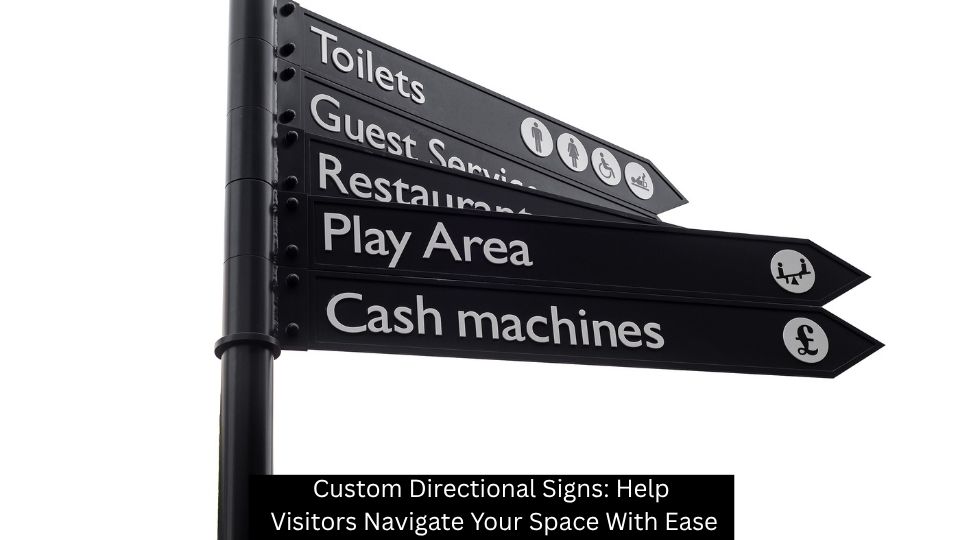
A directional sign that requires the reader to think twice has already failed. Effective directional signage uses simple, unambiguous language, universally understood directional arrows, and clear visual hierarchy that draws the eye to the destination name first. Avoid cluttering directional signs with excessive detail. The goal is not to convey information but to guide action. Every element on the sign should serve that single purpose.
Consistent Sign Family Design
Directional signs work best when they form a cohesive visual system throughout a space. Consistent colors, fonts, arrow styles, and mounting formats allow visitors to quickly recognize and trust directional information wherever they encounter it. A visitor who sees one sign format at the building entrance and a completely different format at the elevator bank is forced to re-orient themselves. Consistency builds confidence and keeps people moving in the right direction.
Types Of Custom Directional Signs
Overhead Hanging Directional Signs
Ceiling-mounted directional signs are visible from a distance and above eye level, making them ideal for large spaces like warehouses, manufacturing facilities, hospitals, airports, and retail centers where floor-level or wall-mounted signs may be obscured by crowds or equipment. They provide guidance from far away and help people commit to the correct route before they reach a decision point.
Wall-Mounted Arrow Signs
Wall-mounted directional signs are the most common format in office buildings, hotels, and corporate campuses. Mounted at eye level beside corridors, at hallway intersections, and near elevators, these signs provide immediate guidance at every decision point. Nashville Signature Signs produces wall-mounted directional signs in aluminum, acrylic, and brushed stainless steel in any size and finish that matches your space.
Freestanding Directional Signs And Stanchion Displays
Freestanding signs on weighted bases or stanchion systems are ideal for temporary or changeable directional needs. Event organizers, conference facilities, hotels, and multi-use buildings rely on portable directional signs that can be repositioned as traffic patterns change. They are also useful for guiding visitors during special events or construction periods when normal routes are disrupted.
Key Points: Custom Directional Signs
| Aspect | Key Point |
| Core Design Rule | Simple language, clear arrows, consistent visual system throughout the space |
| Mounting Types | Wall-mounted, ceiling-hung, freestanding, and door-mounted formats available |
| Material Options | Aluminum, acrylic, brushed steel, PVC, and digital display formats |
| System Planning | Conduct a traffic flow assessment before finalizing sign placement locations |
| ADA Integration | Directional signs leading to accessible routes must meet ADA visual standards |
| Update Flexibility | Modular systems allow panel swaps when space layouts or destinations change |
Discover More
See our complete wayfinding sign systems: https://nashvillesignaturesigns.com/wayfinding-signs/
View our ADA-compliant sign portfolio: https://nashvillesignaturesigns.com/ada-signs/
Frequently Asked Questions
How Do I Determine Where To Place Directional Signs In My Building?
Start with a traffic flow analysis. Identify every major entry point, every key destination (restrooms, exits, parking, elevators, specific suites), and every decision point where a visitor might be uncertain about which way to go. Signs should be placed at every decision point before a visitor needs to make a turn, not after. Nashville Signature Signs conducts facility assessments to map optimal sign placement for your specific space.
What Is The Best Material For Directional Signs In A Professional Office?
Aluminum and acrylic are the most popular materials for professional office directional signs. Brushed aluminum offers a premium, durable appearance that suits corporate environments. Painted acrylic provides more color flexibility at a lower cost. For very high-traffic or high-humidity areas, aluminum is preferred for its structural durability. Nashville Signature Signs recommends materials based on your environment and aesthetic requirements.
Can Directional Signs Be Updated If Our Office Layout Changes?
Yes, and planning for updatability is smart sign design. Modular directional sign systems use changeable face panels that can be printed and swapped without replacing the entire mounting hardware. For spaces that change frequently, this saves significant cost over the life of the sign system. We design our directional sign families with future updates in mind.
Should Directional Signs Include Room Numbers Or Names?
Both are useful and serve different purposes. Room numbers are faster to read for visitors who already have a suite or room number. Destination names like ‘Main Conference Room’ or ‘Human Resources’ are more intuitive for visitors unfamiliar with your numbering system. Including both where space permits gives visitors two ways to confirm they are heading in the right direction.
Getting people where they need to go quickly and confidently is one of the most underappreciated functions a sign can perform. Custom directional signs from Nashville Signature Signs eliminate confusion, reduce staff interruptions, and project organizational professionalism throughout your facility. Whether you need a complete directional sign system or a handful of signs to fill critical navigation gaps, our team is ready to design a solution that works. Reach out to Nashville Signature Signs today to start your project.